
faaizmoideen.com

Uncategorized

Uncategorized

AI Is Transforming Digital Marketing — But Human Creativity Still Matters

AI Is Transforming Digital Marketing — But Human Creativity Still Matters Author: Faaiz MoideenDigital Marketing Student | Aspiring Digital Marketing Professional Introduction Digital marketing is changing at a rapid pace, and Artificial Intelligence (AI) is playing an increasingly important role in this transformation. From content creation and customer analysis to campaign optimization and automation, AI is helping businesses improve efficiency and make faster, data-driven decisions. AI-powered chatbots, personalized recommendations, automated campaigns, and intelligent analytics are becoming common tools for modern marketers. However, even with these technological advancements, human creativity remains an essential part of successful marketing. AI can process information and generate ideas, but human marketers bring emotion, originality, cultural understanding, and authentic storytelling to the table. How AI Is Transforming Digital Marketing AI is no longer simply a technology of the future. It has become a practical tool that marketers can use in their everyday work. Today, AI can help businesses: Generate content ideas quickly Analyze customer behavior and preferences Discover useful SEO and keyword insights Automate email marketing campaigns Create personalized customer experiences Identify patterns and potential market trends Analyze large amounts of marketing data By handling repetitive and time-consuming tasks, AI allows marketers to spend more time on strategy, creativity, and decision-making. The Human Advantage While AI offers powerful capabilities, it cannot completely replace the human side of marketing. Understanding emotions, cultural differences, personal experiences, and authentic communication requires human perspective. Customers often remember brands because of the stories they tell and the connections they create. Human creativity plays an important role in: Authentic communication Creative marketing campaigns Emotional storytelling Building trust Developing a unique brand identity Understanding audience needs AI can support these activities, but the human ability to understand people and create meaningful connections remains valuable. The Future: AI + Human Creativity The future of digital marketing is not necessarily about choosing between AI and humans. Instead, marketers can use AI as a tool to enhance their skills and creativity. Successful digital marketers can combine: AI tools for speed and efficiency Human creativity for original ideas Data analysis for informed decisions Communication skills for meaningful connections Ethical marketing for responsible use of technology When these elements work together, businesses can create more relevant campaigns, improve customer experiences, and develop stronger digital strategies. Skills Every Digital Marketer Should Learn in 2026 As the marketing industry continues to evolve, developing both traditional and AI-related skills can help marketers adapt to new opportunities. Some important areas to focus on include: Search Engine Optimization (SEO) Content Marketing Performance Marketing Social Media Marketing Google Analytics AI-powered Marketing Tools Prompt Engineering Marketing Automation Personal Branding Data Analysis Continuous learning is becoming increasingly important as new technologies and marketing platforms emerge. Final Thoughts Artificial Intelligence is transforming the way digital marketing is planned, executed, and analyzed. However, AI does not make human creativity irrelevant. Instead, it gives marketers new ways to work faster, explore ideas, understand data, and improve their strategies. The future of digital marketing will be shaped by professionals who can adapt to new technology while maintaining creativity, authenticity, and a strong understanding of their audience. AI can provide the tools and insights, but human creativity can turn those insights into meaningful marketing experiences. About the Author Faaiz Moideen is a Digital Marketing Student and aspiring digital marketing professional with an interest in SEO, content marketing, branding, and AI-powered marketing strategies. His goal is to explore modern digital marketing techniques and help businesses build stronger online visibility through creative and data-driven strategies.

Uncategorized

GEO: The Future of Search in the Age of AI

GEO: The Future of Search in the Age of AI The way people find and consume information online is changing rapidly. Search is no longer limited to typing a few keywords into Google and browsing through a list of website links. AI-powered platforms can now understand detailed questions, analyze information from multiple sources, summarize key findings, and provide direct, conversational answers. This shift is creating a new area of focus in digital marketing: Generative Engine Optimization (GEO). For businesses, marketers, and content creators, understanding GEO can help them adapt their online content to the evolving way people search for and discover information. What Is GEO? Generative Engine Optimization (GEO) is the practice of creating and structuring content so that AI-powered search and generative systems can understand, interpret, and potentially use it when generating responses. Traditional SEO primarily focuses on improving a website’s visibility in search engine results. GEO expands this approach by considering how information may be interpreted and presented within AI-generated answers. For example, instead of visiting several websites to research digital marketing, a user might ask an AI platform: “What digital marketing strategies can help a small business grow?” The AI system may analyze information from different sources and provide the user with a summarized answer. This makes it increasingly important for businesses to publish content that demonstrates genuine expertise, answers relevant questions, and provides useful information. Why Is GEO Important? AI-powered search is changing the way people interact with online information. Users can now ask complex, conversational questions and receive summarized answers without necessarily visiting several websites. As a result, online visibility is no longer limited to appearing in traditional search results. A business or website may be mentioned, referenced, or used as a source within an AI-generated response. A GEO-focused content strategy can help businesses work toward: Greater visibility across AI-driven search experiences Stronger online brand presence Increased discoverability for conversational searches More useful and informative content Greater opportunities to demonstrate expertise and credibility However, GEO does not guarantee that a website or brand will appear in AI-generated answers. The goal is to create high-quality information that can be easily understood and genuinely helps the audience. GEO vs SEO: What’s the Difference? SEO and GEO share many principles, but their primary areas of focus are different. SEO focuses mainly on improving a website’s visibility and performance in traditional search engines. GEO focuses on making content clear, useful, trustworthy, well-structured, and easy for generative AI systems to understand and potentially incorporate into their responses. This does not mean traditional SEO is becoming irrelevant. Technical SEO, website performance, relevant keywords, useful content, internal linking, structured information, mobile optimization, and website credibility continue to play an important role. Rather than viewing GEO as a replacement for SEO, it is more useful to see it as an additional consideration as search continues to evolve. How to Prepare Your Content for GEO 1. Create Content That Provides Real Value The primary goal of your content should be to help your audience. Instead of creating pages simply to target keywords, focus on answering genuine questions, explaining topics clearly, and providing information that readers can actually use. Original examples, practical recommendations, relevant data, and detailed explanations can make your content more useful and meaningful. 2. Answer Real User Questions Search behavior is becoming increasingly conversational. Instead of searching only for short phrases, users are asking complete and detailed questions. For example: Traditional search:“SEO benefits” Conversational search:“How can SEO help a small business reach more potential customers?” Creating content around real questions can make your website more useful for both your audience and modern search experiences. 3. Demonstrate Genuine Expertise Trust is an important part of high-quality content. Show your knowledge through practical experiences, case studies, original research, examples, observations, and useful insights. Providing clear information about the author or organization behind the content can also help establish credibility. Content that simply repeats information available everywhere may provide less value than content that includes genuine experience and unique perspectives. 4. Make Your Content Easy to Understand Clear content structure benefits both people and modern search technologies. Organize your information using: Descriptive headings Short paragraphs Bullet points Clear definitions FAQs Examples Logical sections Avoid unnecessary jargon and complicated explanations. Make important information easy for readers to identify and understand. 5. Strengthen Your Online Authority GEO is not limited to individual blog posts. Your overall online presence can contribute to how your business is understood and represented across the web. Keep your business information consistent across your: Website Social media profiles Business listings Industry publications Online directories Relevant professional platforms A consistent digital presence can help create a clearer and more credible representation of your brand. 6. Publish Original Information Originality can make your content more valuable. Whenever possible, include information that comes from your own knowledge, experience, or research, such as: Personal experiences Original observations Case studies Customer insights Research findings Practical experiments Unique examples Professional perspectives Content that offers something genuinely useful and distinctive can provide more value than content that simply summarizes information already available online. How SEO and GEO Can Work Together GEO should not be treated as a replacement for traditional SEO. Instead, SEO and GEO can complement each other as part of a modern digital marketing strategy. SEO helps your website become discoverable through traditional search engines, while GEO encourages you to create content that is structured, informative, and suitable for AI-driven search experiences. A well-rounded strategy can combine: Technical SEO Helpful and original content Clear website architecture Relevant keyword research Strong internal linking Authoritative information Conversational content Answers to real user questions Consistent online brand information The foundation remains the same: create useful content for real people first. What Could the Future of Search Look Like? AI is already influencing how people discover information, products, services, businesses, and ideas. As AI-powered search continues to develop, the meaning of online visibility may also continue to expand. Businesses may need to think beyond the traditional question: “How can I rank

Uncategorized

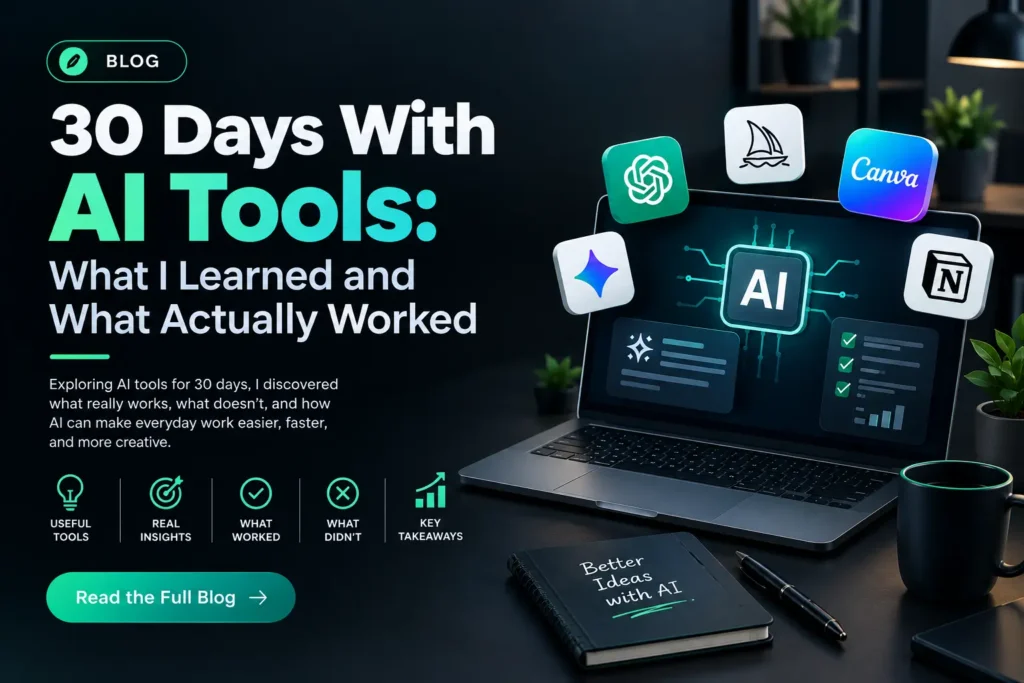
30 Days With AI: Lessons Learned, Tools Tested, and What Worked

30 Days With AI: Lessons Learned, Tools Tested, and What Worked By Faaiz Moideen | Digital Marketing Student & Digital Marketing Enthusiast Artificial Intelligence is quickly becoming an important part of how we work, learn, and create. As a digital marketing student, I wanted to explore AI beyond the theory and understand how these tools can actually be used in real-world situations. Instead of just reading about what AI can do, I decided to test different AI tools myself and discover what genuinely worked, what didn’t, and what I learned along the way. To put AI into practice, I spent 30 days exploring and testing different AI tools across writing, research, design, productivity, and digital marketing. The goal was to see how useful these tools could be in real-world tasks and how they could improve the way I work. The most important lesson I learned throughout the experience was surprisingly simple: Why I Started Exploring AI rewrite Digital marketing involves a wide range of time-consuming tasks, including content planning, topic research, graphic design, campaign management, and project organization. I wanted to explore whether AI could make these tasks faster and easier while still maintaining the quality and originality of my work. By using the right AI tools, I was able to spend less time on repetitive tasks and create more room for learning, creativity, strategic thinking, and effective planning. AI Tools That Became Part of My Workflow 1.  ChatGPT ChatGPT was one of the most frequently used AI tools throughout my 30-day experiment. I used it for brainstorming ideas, organizing blog topics, refining content, developing social media ideas, and gaining a better understanding of various digital marketing concepts. It became a useful tool for improving my workflow and exploring new ideas more efficiently. Useful for: Content Idea Generation Blog Content Planning SEO Strategy & Research Social Media Content Ideas Learning & Skill Development Productivity & Workflow Improvement 2. Canva AI Creating marketing visuals became much easier for me with Canva’s AI-powered features. During my 30-day experiment, I explored Canva AI to create social media graphics, presentations, promotional designs, and other types of visual content. Useful for: Social media graphics Presentation designs Marketing creatives Promotional content Visual content creation One of the main benefits was that it reduced the time I spent on repetitive design work. This allowed me to focus more on the idea, message, and purpose behind each design. 3. Grammarly Clear and effective communication is an important part of digital marketing. Grammarly helped me improve my writing by identifying grammar mistakes, improving sentence structure, and making my content easier to read. I found it especially useful when working on professional content, blog drafts, and other written materials before publishing them. 4. Notion AI Notion AI made it easier for me to manage my ideas, notes, and daily tasks in an organized way. I used it to structure notes, organize projects, summarize information, and plan different activities. When learning multiple areas of digital marketing at the same time, having an organized system helped me keep track of my ideas and manage my work more effectively. 5. Perplexity AI Research was another area where AI helped me work more efficiently. I used Perplexity AI to explore different topics, find relevant information, and discover sources that I could use for deeper research. However, one important lesson I learned was that AI-generated information should always be reviewed before being used. For important topics, I made sure to cross-check information with reliable and trustworthy sources. What 30 Days of Experimenting With AI Taught Me The biggest lesson I took from this 30-day experiment is that AI works best as a supporting tool rather than a replacement for human thinking. AI can make tasks such as brainstorming, research, organization, and repetitive work easier. However, successful digital marketing still depends on human creativity, understanding, and judgment. A digital marketer needs to understand the target audience, identify their needs, create meaningful messages, communicate a brand effectively, and make sure the information being shared is accurate. AI can support these processes, but the important decisions still require human involvement. Lessons I Learned From Using AI Use AI as a Starting Point I learned not to treat AI-generated content as the final answer. Instead, I use it as a starting point and then add my own ideas, experience, creativity, and perspective to make the content more original. Always Verify Important Information AI tools can sometimes provide incorrect, incomplete, or outdated information. Because of this, checking important facts and comparing them with reliable sources is an important part of using AI responsibly. Use AI to Save Time One of the biggest advantages I experienced was saving time on repetitive tasks. This gave me more opportunity to focus on strategy, creativity, learning, and other areas that require human thinking. Choose the Right Tool for the Task I also learned that no single AI tool is perfect for everything. Exploring different platforms helped me understand which tools are more useful for writing, research, design, productivity, and content planning. The Growing Role of AI in Digital Marketing AI is becoming increasingly involved in different areas of digital marketing, including content creation, customer communication, research, data analysis, personalization, and campaign planning. As AI technology continues to develop, digital marketers will need to understand how to use these tools effectively and responsibly. I believe the real value comes from combining AI technology with creative thinking, marketing knowledge, and a strong understanding of people. Final Thoughts My 30-day experiment with AI changed the way I look at technology and its role in everyday work. Throughout the experience, AI helped me save time, organize ideas, research topics, and improve different parts of my workflow. At the same time, I learned that getting the best results from AI requires human judgment, creativity, and responsibility. For me, AI is not about replacing original thinking. It is about using technology to create more time for better thinking, creativity, and learning. As I continue my journey in digital marketing,

Scroll to Top